Simple Bootstrap Theme

Why PBL Prepares Children for the Future — and How We Do It at MEES

What does meaningful learning look like in practice?
This article takes an inside look at how Project-Based Learning works at MEES International School, and why it matters. Through real projects, mixed-age collaboration, design thinking, and forest learning, students build confidence, curiosity, and the skills they need for a future that is still taking shape.

Introduction — Learning Through Meaningful Experiences

At MEES, we believe children learn best through experiences that feel real, purposeful, and connected to their lives. Project-Based Learning (PBL) is how we bring this belief to life every day. Our students don’t just learn facts — they explore ideas, investigate questions, solve problems, create things, and share their work with others.

PBL helps children develop the knowledge they need for school, but it also helps them develop skills for a future none of us can fully predict. They build confidence. They learn how to work with others. They discover their interests. They take on challenges and learn how to navigate them. They start to understand who they are and who they want to become.

As a school, we combine PBL with Design Thinking, mixed-age cohorts, daily inquiry practices, and a unique Forest School program. These elements together shape the learning culture we’re building at MEES — one where students are trusted, supported, and encouraged to lead their own learning.

Why PBL Matters — Skills That Last a Lifetime

Real learning through curiosity and creation
One of the things I love most about PBL is that children get to follow their curiosity. They get to explore ideas, test them, discuss them, challenge them, and improve them. This naturally brings together creativity, problem-solving, language, math, collaboration, and communication.

During our Level Up project, when students explored the question “What is a game?”, they made games while they were playing them. They tested rules, broke them, fixed them, and broke them again. One group invented an onsen jail loop that players could barely escape from; another created a multi-currency system; another built a set of mechanics that allowed players to save moves and spend them later. These examples weren’t planned by teachers — they grew naturally from student ideas.

Confidence through experience
Confidence isn’t something you can “teach.” It grows over time, through experience. Through trying something and realising you can improve it. Through receiving feedback. Through seeing your ideas become something real. Through facing a challenge and discovering that, with a bit of effort and guidance, you can do more than you expected.

PBL gives children the chance to build this kind of confidence. It happens when they create a prototype, speak to an expert, share their work publicly, or solve a real-world problem — like when a group of students assessed and fixed a broken barrier at a local park using Design Thinking.

How We Do PBL at MEES — Blending Structure and Freedom

Design Thinking as our structure
While PBL is our pedagogical approach, Design Thinking is the framework that gives projects momentum and clarity. Students move through stages — Empathise, Define, Ideate, Prototype, Test — but every project looks different because the students themselves shape the direction.

This framework helps students know where they are in their project and what they can do next, without restricting their creativity.

Mixed-age cohorts
Our mixed-age structure is a distinctive part of MEES. It mirrors the real world far more than same-age classrooms do. Younger students learn to share their ideas and listen to others; older students learn to lead, to support, and to stay open-minded. Mixed-age collaboration happens naturally, every day. It’s one of the things that makes our school truly unique.

A core Forest School program
Our Forest School program is not an “add-on.” It’s a living part of our PBL curriculum. Two whole-school Forest Days this year sparked new ideas, project possibilities, and connections to nature and local history. Students explored the Sakura Castle ruins, observed wildlife, gathered natural materials, harvested daikon from our Forest Farm (and measured it back at school!), and began imagining new projects like mapping the forest, studying insects, building forts, and even forming a walking group.

Transdisciplinary learning
Math, Language, and other subjects are not taught in isolation. They appear where they naturally belong — inside project work. You cannot test a game prototype without data. You cannot build a structure without measurement. You cannot share ideas without language.

Students made deep connections when comparing Ohajiki rules and variations during our game study, or when building characters for an RPG during language lessons, or weighing daikon they harvested themselves in the forest.
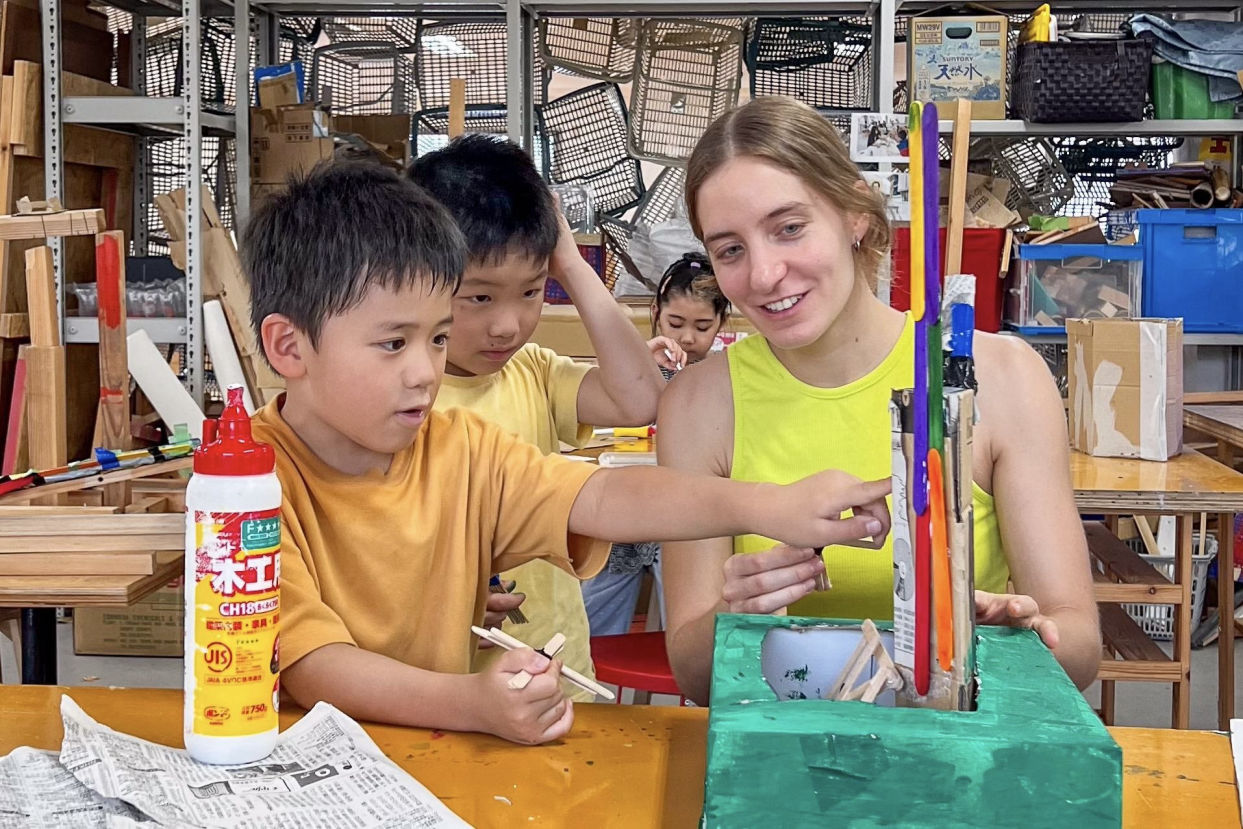
Children learn best by exploring, creating, and solving problems.

What PBL Looks Like — Real Stories From Our Classrooms

The Level Up Project
Students are now researching games they love — Minecraft, Roblox, kart racing, Uno, Prodigy. They look at game mechanics, history, rules, player experience, and what they would change. They’re preparing to design their own game prototypes, and we’ve even invited indie game developers to give them feedback.

Daily personal projects
Every day, students also work on personal projects based on their interests: building transport systems, teaching chess, designing playgrounds, coding apps, improving art skills, building digital or physical prototypes. Teachers act as mentors and coaches — supporting students to turn ideas into full projects with goals, plans, and next steps.

Mixed-age collaboration
One moment that really stood out this year was when an older student saw a younger student’s climbing-frame prototype. He loved it and wanted to join. They researched together, visited the park together, sketched ideas together, and built models of different scales. That collaboration wasn’t assigned — it grew naturally because both of them cared about the idea.

A breakthrough moment
One younger student has been making huge strides in his learning. He created wildlife for a fictional country during our Who We Are project, built a 3D prototype of it, and then brought it into his writing weeks later. In Level Up, he realised — completely on his own — that the best way to teach others how to play a game was not through long rules, but by showing the controls and letting people explore. “Learn by doing” isn’t something we said to him — it was something he discovered himself.

For me, moments like this show what PBL is really about.

What Parents Often Wonder About PBL

Do students still learn the core skills?
Absolutely. They learn everything they would in a traditional school — but in a more connected and meaningful way.

How do teachers support the learning?
We guide, coach, mentor, observe, and design experiences to help students grow. Student agency does not mean teachers step back completely — it means we support students to lead their own learning safely and successfully.

Does PBL support all kinds of learners?
Yes. When students feel supported, seen, and trusted, they feel confident to explore, try, and grow. PBL is adaptable and flexible, and can meet many learning needs.

What We Hope Children Will Remember

When I think about what I hope children take with them from their time at MEES, I think about the experiences that shaped me as a child.

I remember my Grade 2 teacher who created a warm, well-stocked library where I fell in love with stories. I remember the art teacher who stayed after school to help me build a stage set in high school — and the cheers from the audience on opening night when the design finally came to life. And I remember being 6 years old, standing with my friends and teachers as we opened the classroom doors onto an untouched, snow-covered field and ran laughing into the white expanse.

Experiences like these stay with us for a lifetime. That’s why they matter.

I hope our students look back and remember:
• that their ideas mattered
• that they were trusted
• that they were seen, known, and celebrated
• that they learned to feel confident in who they are

And I hope they feel ready to pursue the interests they discover here — wherever those interests may lead.

A Closing Thought — For the Future They Will Shape

Project-Based Learning doesn’t just prepare children for the next test or the next school year. It prepares them for life. It teaches them how to think, how to adapt, how to collaborate, and how to believe in themselves.

We don’t know exactly what the world will look like when they are grown, but we know this: children who trust themselves, who know how to learn, and who feel confident in their ideas will be ready for whatever comes next.

At MEES, we’re honored to help them begin that journey.

See Project-Based Learning in Action at MEES Tokyo

If you are looking for an international school in Tokyo where learning is built around real projects, student curiosity, and strong relationships, MEES offers a thoughtful, child-centered approach to PBL.

Read More:

© Copyright 2026 MEES | ミース     -       Rankukan Co., Ltd. – 蘭空間株式会社